
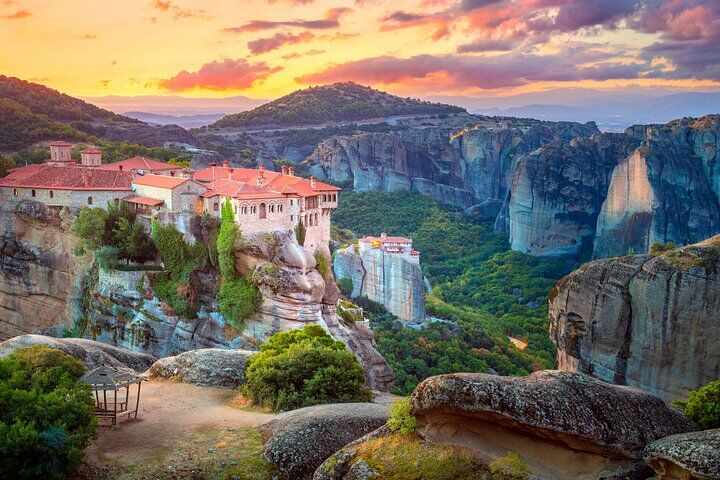
Rising out of the Thessalian plain in central Greece, Meteora’s sandstone pillars look almost unreal, and perched atop several of them are monasteries built by monks seeking isolation from the world below. Founded from the 14th century onward, these six surviving monasteries, once numbering around two dozen, remain active religious communities as well as one of Greece’s most striking UNESCO World Heritage sites.
Related: Delphi Ancient Site: A Complete Guide to Greece’s Oracle of Apollo
Top-Rated Meteora Monasteries Tours & Tickets
Best Things to Do at Meteora
Visit the Great Meteoron Monastery
The largest and oldest of the surviving monasteries, Great Meteoron sits atop the highest rock and houses a museum with religious artifacts, manuscripts and a small ossuary. The climb up its carved rock steps is steep but short, and the summit views over the valley are the payoff.
See the Frescoes at Varlaam Monastery
Varlaam’s katholikon holds richly colored 16th-century frescoes covering nearly every interior surface, among the best-preserved Byzantine religious paintings in the region. The monastery also displays the original wooden barrel once used to haul supplies up the rock face by rope and net.
Watch the Sunset from a Viewpoint
Several roadside pullouts and short trails around Meteora offer sweeping views of the rock pillars glowing orange and pink at sunset, with monasteries silhouetted against the sky. It’s a popular, low-effort activity that doesn’t require entering any single monastery.
Explore Roussanou Monastery
Smaller and more delicate-looking than Great Meteoron, Roussanou is run by an order of nuns and sits on a narrower pillar connected by a bridge, making it one of the more photogenic and accessible monasteries for visitors with limited time or mobility.
Hike the Old Monk Paths Between Monasteries
Rather than driving between sites, sections of the original footpaths and carved steps once used by monks can still be walked today, connecting several monasteries through forest and rock. It’s a quieter, more physical way to experience the landscape between the postcard stops.
Best Time to Visit
Spring and autumn offer the most comfortable hiking and photography conditions, while summer heat can make the exposed stone paths and steps uncomfortable by midday. Each monastery closes on a different weekday on rotation, so check ahead if you have a specific one in mind.
How to Get There
Meteora sits just outside the town of Kalambaka, about a three-hour drive or train ride from Athens, making it feasible as a long day trip or, better, an overnight stay. A car or organized tour is the most practical way to move between the scattered monasteries, since they’re too spread out to walk between comfortably in a single day.
Good to Know
Modest dress is required at every monastery, meaning covered shoulders for everyone and long skirts or wraps for women, though most sites keep spare wraps at the entrance for visitors caught unprepared. Each monastery charges a small individual entry fee, and visiting three or four in a day is a realistic, unrushed pace.
Meteora rewards visitors who slow down rather than rush between all six monasteries. Pick two or three that genuinely interest you, build in time for the viewpoints, and the rock pillars alone will justify the trip.





Write Your Review
No reviews yet. Be the first to share your experience!